
Keen on outdoor activities that I am lucky enough to practice in the Alps, I opened a section in this blog dedicated to trail running, which I indulge in as a dilettante, far from popular races. As the section dedicazte to climate change and its consequences on living things, it offers unique content in the sense that it is made up of experiences and original ideas which I hope will inspire runners who will hopefully share comments.
Contents
- My motives for trail running
- Trailer equipment
- Before and after the trail
- The dilettante trailer technique
- Support on the front of the foot is the basis of an effective technique…
- …but not only…
- To each their own pace
- Become a quadruped
- 4 dominant muscle groups for 4 basic steps
- The rolling terrain step
- The false flat step
- The steep climb step
- The steep downhill step
- For harmonious management of the trajectory
- Some additional advice

My motives for trail running
Over the years, trail running has become one of my favorite hobbies because contact with nature is at the heart of my needs, for the reasons explained in the Collebert section.
This activity enables to cover large distances on the least passable terrain which often turns out to be the wildest, and thus to discover new horizons beyond the beaten paths.
In the Alps where we rarely come up against the property limits which mutilate most of our anthropized spaces, our mobility and our imagination are both boundless. Thanks to the vertical dimension which makes our playground unique, I notice we have the privilege of living there in 3D.
The furtiveness of an activity practiced at a run pace offers the advantage of freeing up time for family life which too often competes with my passions.
Unlike the expanding mass of trail runners who are driven by competition, I practice trail running alone because I do prefer to compete against myself. Far from the crowd, I stay away from the increasing popular races.
This is how I am free to decide the time and place of my trails, which allows me to escape the dictatorship of time and place that everyone else suffers during their professional life where they depend on an agenda decded by others. Furthermore, I have the privilege of avoiding bad weather that a organization by others would impose on me.
I like the material sobriety of this democratic sport par excellence, since it is accessible to everyone regardless of gender, constitution or age. And this regardless of one’s income since trail running, which requires nothing else than a pair of shoes, relies only on the body and the mental.
On this last point, I noticed that running helps dissipate negative emotions by re-establishing fertile thinking which encourages the emergence of new ideas. This allows me to resolve a number of tricky situations and find out a positive outcome to most of those which appear to me to be dead end. I don’t know the reasonwhy of this providential process, but I know that relaxing virtues of running are correlated with the secretion of endomorphins which gives an addictive character to this activity to which we quickly become unwilling slaves.
Besides the previous motives, I am undoubtedly driven by unconscious animal impulses which come from our singular biological past marked by the pursuit over very great distances of prey which ensured our subsistence. In the light of recent discoveries, Chis Mc Dougal (Born to Run, Ed. Paulsen, 2022) explains how human species has specialized in hunting to exhaustion which has given an access to the meat necessary for growth of his brain. This adaptation dates from the intermediate period between when man became biped two million years ago and when he invented the spear two hundred thousand years ago. Among other predispositions, Homo Sapiens is advantaged by its hairless body able to sweat to cool itself, while its prey, handicapped by their hairy fleece, inevitably succumb to hyperthermia after long chase. By its extraordinary endurance in the animal kingdom, Homo Sapiens would have supplanted its close relative Neanderthal who was penalized by his strong hair coupled with a bulky corpulence. From there, modern man would have won the competition for protein food at a time when large mammals were becoming less and les common as the great glaciations arise. Runners by nature, we inherit the well-being that trail running provides, from this singular background which makes our species the champion of ultra-long-distance run.
Edified by this new knowledge, I was about to reconsider my reluctance to practice ultra-trail, which I wrongly suspected of being unnatural and therefore harmful to the body. That was without counting on a recent article that actually validates this hypothesis for the specific case of extreme ultra-trails only (The springs of performance in ultra-endurance, Le Monde, October 24, 2023). Beyond the 100-mile threshold, the authors of this article (Nicolas Berger, Guillaume Millet, etc.) report a series of specific problems such as alterations of the locomotor and respiratory muscles, digestive disorders, renal complications, and hypothermia. They deduce that the distances of the extraordinary events of ultra-trail are probably out of proportion to those covered by our ancestors during exhaustion hunts. So I repressed my ardor to limit myself to distances below the critical threshold of 100 km knowing that under this condition, many sources unanimously confirm the benefits of running for the body and mind. In this regard, hygienic motivations are not foreign to my passion for trail running.
To close the subject of those that underlie my practice, I would mention one of the unsuspected facets of this activity which consists in the playful pleasure of a technique that I continue to develop over time. Focused on my postures and sensations, I discover by applying certain basic movements that I had assimilated in hiking, cross-country skiing, climbing or mountain biking for example, that there are multiple ways to use your body to progress on the trails. Because running potentially mobilizes all the muscles and joints in ways that vary depending on the context and the person, it is one of the most complex sports disciplines there is and paradoxically the most banal. Today, I get as much enjoyment from it as young children who experience the incredible mobility it provides, before becoming jaded by this ordinary routine when they grow up.
Reading the excellent work by Chris Mac Dougal cited above, the author evokes the quest of an eminent trail theorist – Joe Vigil – who tirelessly tried to uncover the secret of the success of the best. After eliminating all objective physical performance factors such as morphology, training or technique, he came to the counter-intuitive conclusion that it is psychological factors that make the difference, to the advantage of the female sex, which stands out in ultra competitions. His point of view is shared by a growing number of specialists such as Alex Hutchinson. Cited in the excellent manual « La clinique du coureur » (Ed. Mons, 2022), the proponents of this theory are now trying to push the limits of performance by working on the mind. Conversely, the researchers who have expressed themselves in the columns of Le Monde persist in invoking other physical determinants such as nutrition or the quality of muscle fibers.

According to Joe Vigil, if pleasure and motivation are the keys to the success of trailers, I am glad to find in my practice as many motivations as those listed above. Needless to say that my modest level of performance is far below the one of most performers who take part to the increasingly less confidential world circuit of ultra competitions with, on the Mont Blanc tour for example, more than 4,000 candidates each year for 160 km and 10,000 m of elevation gain!
Trailer equipment
To be sure not to forget anything, I drawn up a checklist of the equipment required for trail running and I systematically refer to it before each trail.
Shoes
After having worn many pairs of increasingly technical and expensive shoes over the years, I rediscovered by reading the works of Chris Mc Dougal and Eric Orton (No Limit, Paulsen editions, March 2017), the benefit of support on the forefront of the foot which would explain the success of the Tarahumara Indians, the Kenyans and the Massai in ultra competitions. This principle goes hand with the use of basic models with flat soles which are therefore designed without any extra thickness supposed to fill the space between the arch of the foot and the ground. This zone becomes the natural support surface for the runner who has moved in this way since the dawn of time, until the advent of so-called modern shoes.
In the absence of compensation by the soles, it is the numerous muscles of the foot which guarantee the stable support of the runner, thereby disqualifying the corrective models intended, among other marketing targets, for pronators or supinators. The muscles and joints that make up the foot also provide cushioning and rebound through which the plastic properties of modern soles become obsolete. And especially since these properties are definitive, while our musculoskeletal system, whose conformation constantly adapts to the relief, is able to balance at any moment the relationship between cushioning and rebound depending on the terrain, the fatigue or age for example.
Validated by my experience, the recommendations of the authors quoted above – one is in fact the coach of the other – encouraged me to reject wedge soles to limit my expectations regarding trail shoes to grip effective, good resistance to wear, reinforced support for the upper part of the foot and above all, sufficient space to free its front part.
This key condition can be satisfied on one hand by the choice of a brand such as Brooks or Saucony – on the condition of chosing one size more – and on the other hand by a simple tip which came up to me when I was looking to relieve the Morton syndrome from which I have been suffering for several years. Simple and costless, it consists of tying a knot on the laces halfway up the upper, so that the shoe is only tightened above this attachment point, thus freeing up the necessary space at the front of the foot. so that he can do his job normally.
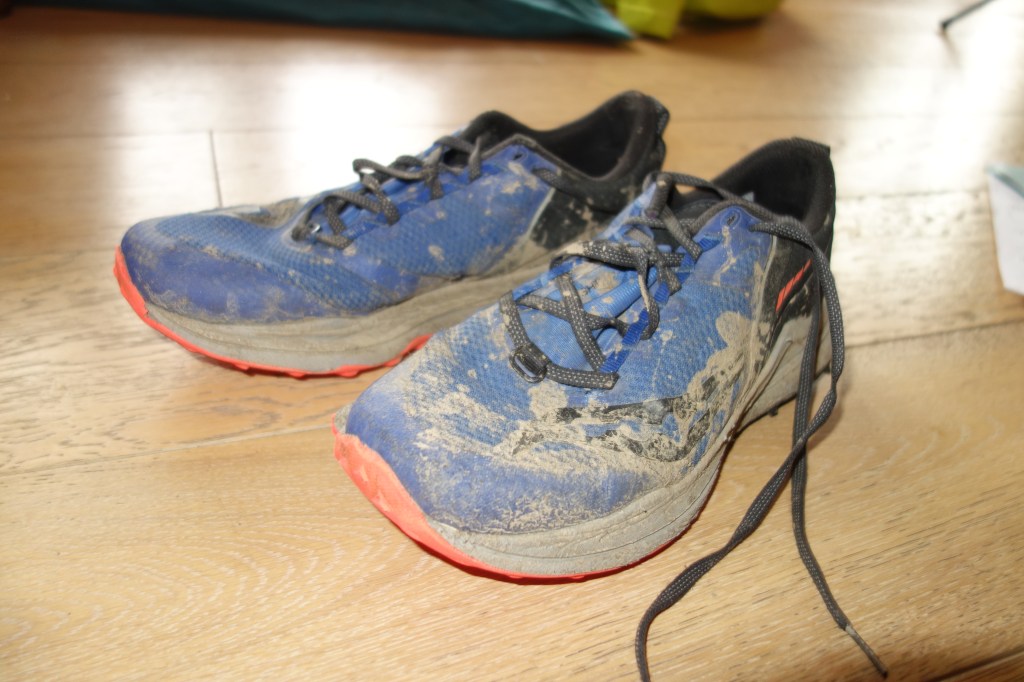
As a plain runner who covers an average distance of 40 to 60 km per week, I invest in one pair of shoes per year. Every two years, I replace the model whose sole is suitable for dry and stony trails, while the year after I replace the one which is suitable for muddy ground.
Trail poles
To minimize the weight of the poles, I chose carbon which nevertheless has the disadvantage of being fragile.
Instead of telescopic or articulated models which are weighed down and weakened by their folding system, I use single-section poles as I use them almost constantly.
I attach them to my back during steep passages where I need my hands to be able to climb. While along the flat and rolling parts where their handling would be difficult, I hold them at arm’s length using them as balancers.
A length such that they stop at armpit height enables the height of the hands to be adjusted to the progression technique and especially to the slope, as is the case in hiking ski.
In this purpose, a generous handlebar tape type padding on their upper part improves grip along the grip area, when it has not been already covered with a suitable covering by the manufacturer.

Clothes
MTB mittens dampen the vibrations of poles on hard terrain, cushion possible falls without scratching your hands, prevent blisters and have the advantage of absorbing perspiration.
In hot weather, I wear shorts and a light, breathable t-shirt. Outside of summer or at altitude, in cool temperatures I use an insulating polyester thermal garment topped with a soft shell or fleece, without forgetting a buff and a pair of warm, light gloves like those used for nordic ski.
To prevent from wind as well as possible rainfalls, I systematically bring a light and breathable waterproof clothing that I attach to my carrying system at the back.
Above short cotton trail socks which are intended to reinforce the support of the foot and ankle and which must be fitted to the right and left sides, I wear high polyester socks whose role is to compress the veins to ensure tonic and efficient circulation to the top of the calves. As with shoes, it is important to avoid socks that are too tight at the front of the foot, as this could prevent this area from doing its job or, worse, trigger possible Morton’s syndrome.
A cap under which I place a light fabric intended to protect the neck from the sun, completes the outfit. Thin and light, this cotton piece, which measures approximately 1 m², can eventually be used as a towel or loincloth. When the opportunity arises in summer, I soak it in water to cool down my head. Finally, its striking red or blue color can be used to stand out in the landscape if necessary.
Small equipment
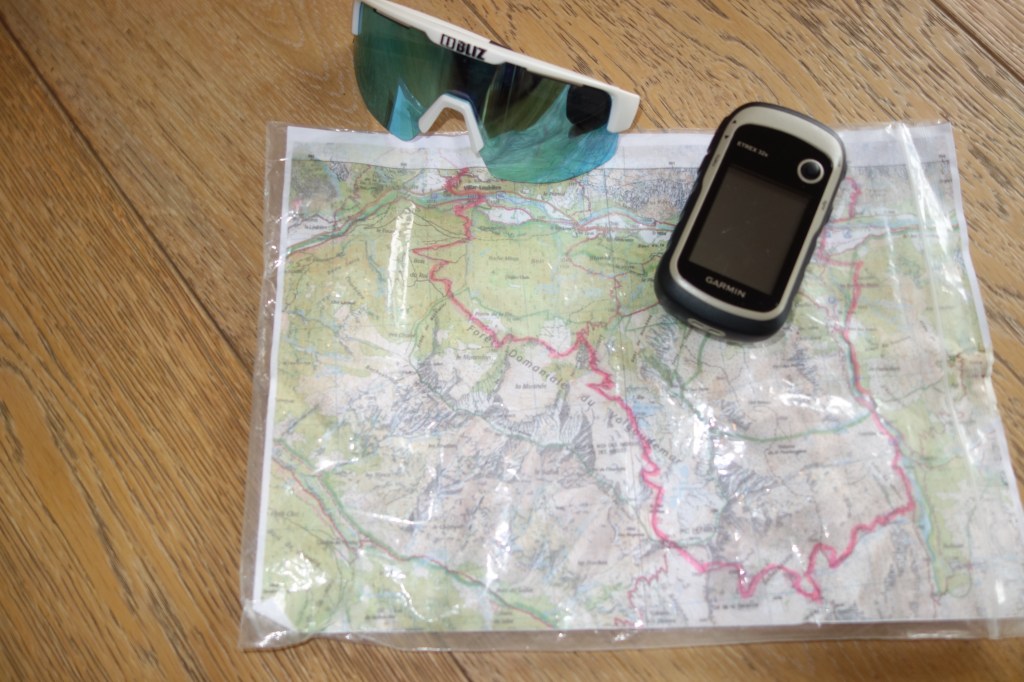
Polycarbonate sunglasses with an index of 3 (or 4 due to the risk of strong sunlight in the event of snow) suitable for cycling or nordic ski are the best. Designed with a wider field of vision, they are perforated around the edge of the lenses to reduce the risk of condensation. A polarizing treatment facilitates the transition between shaded and sunny areas. I personally use the Bliz brand, some models of which adapt perfectly to my little bird’s head because in my opinion it represents the best value for money.
Wearing corrective glasses, I reserve an old, used pair for sports, which I put on the visor of my cap in order to put them quickly on my noze when an examination of the trail is necessary. Its branches are connected at both end by a thread which would hold them at the back of the neck if they were to fall.
A high-performance GPS equipped with a reliable and precise barometric altimeter is compulsory. Compact and powered by standard rechargeable batteries, it makes possible to record your track throughout the path. If the trail has been downloaded from the Internet, it is used to orient yourself if necessary, for example when visibility is poor due to fog or darkness. To do this, it must have a good resolution color screen and include a sufficiently detailed base map. I personally use the free open source OSM (Open Street Map) basemap that Garmin installs by default on all its devices. For years, I have been loyal to the Etrex series from this manufacturer and recognize as its only weak point the slowness of a processor which remains unchanged since the first model. Instead of a fragile touch screen sensitive to rain, the Etrex has buttons and a joystick that make it robust whatever the situation. Despite an old fashioned user interface, it offers all the desirable features and its value for money is unique.
When the lanscape is worth it, a Digital Camera stored within easy reach makes sense.
Useful for communicating with loved ones, a charged smartphone also allows you to take photos and can replace the GPS. Combined with a free app such as IGNrando or Outdooractive, this device is a very convincing alternative to GPS. With the advantage of being able to zoom on the screen with your fingers to distinguish what poor eyesight could not see on the paper map.
Protected by a transparent plastic bag, a color photocopy of the portion of the map where the route is marked with Stabylo is used for orientation. When I run out of time to print, I substitute a photo of the paper map taken with my smartphone.
To complete everything, I bring a compass, a set of spare batteries (charged) for the GPS, a whistle, an energy bar or a snack for long distances, my ID card, a little money and a plastic bag to protect items from rain.
Carrying and drinking system
To prevent tossing, I use a carrying system which tight the load to the body. If possible, this system has a few pockets ideally distributed around the breast, with a good accessibility to those where I store essential accessories such as the paper map, the camera or the smartphone.
After using a (resistant) Camelback brand backpack for many years, I sometimes now wear a trail vest suitable for shorter routes.
A 1.5 to 2 L bladder must adhere to the body by being placed against the back. Accessible via a hose, it allows you to hydrate at any time using an isotonic solution that I prepare by adding a tablespoon of sugar and a teaspoon of salt to the water.
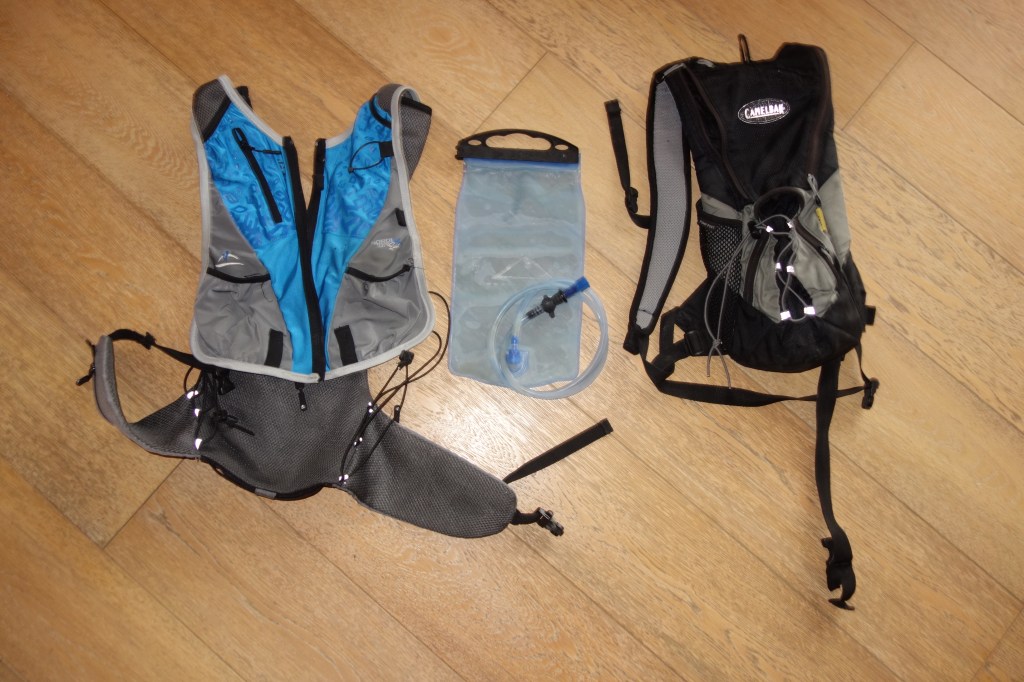
It is in a small bag strapped to the back of the bladder and suspended by a small carabiner from the upper part of the carrying system, that I store the waterproof clothing and any snack contained in a compact insulated bag.
Before and after the trail
I report with a Stabylo on the color paper photocopy of an map at 25,000th, the route that I imagined for myself by reading the lanscape or better, on sight during a previous visit to the sector. Where applicable, I draw inspiration from the route recorded by other trailers on websites such as visugpx.com, openrunner.com or visiorando.com. In this case, I take the precaution of downloading their track in GPX format on my GPS, in addition to the paper map. In the absence of GPS, I download it on my smartphone. To compensate for the possible absence of an Internet connection on the trail site, I take the precaution of displaying the route at home so that the base map is archived in advance in the device’s cache memory.
If I have to be alone in my vehicle, I don’t forget to submit a carpooling offer on the Internet in advance in order to minimize the carbon footprint of my trip. Disgusted by the outrageous commissions that BlaBlaCar charges on journeys, I recently turned to Mobicoop.
When leaving my home, I take care to cut my toenails to prevent them from coming off if they could hit the front of my shoes. It is also the best way to protect socks from premature wear.
I make sure to coat parts of the body exposed to the sun with sunscreen, starting with the nose, neck and forearms which are particularly vulnerable.
I check the level of the GPS batteries which must be at least 2/3 of their capacity, just like that of the smartphone.
I mark the altitude of the starting point in order to be able to calibrate my GPS once there.
I send a photo of the route that I had plotted on the map to a loved one’s mobile and I give them an idrea of the expected return time. I estimate the ascent time on the basis of 600 to 1000 m of D+ per hour depending on the slope and the length of the route for which my average speed generally varies between 4 to 6 km/h including return.
On my way to the starting point of the trail, I sip 75 cl to 1 l of water to hydrate myself.
At the start of the trail, I don’t forget to calibrate the barometric altimeter on my GPS.
For the first 15 or 20 minutes, I walk at an increasingly faster pace in order to gradually warm up my muscles and joints. It is the ventilation of my muscles through the lungs that limits the increase in speed, thus enslaved to the progression of my VO2 max.
This gradual increase in speed has the advantage of using the most economical movement techniques, which are those that I recommend in this blog, whereas a fast start generally leads to mobilizing the thighs as a priority and to favoring speed to the detriment of saving resources.
After a few minutes, I tighten the laces of my shoes to ensure firm support for the foot at the ankle. The goal is not to contain the lateral play of the joint in order to prevent a sprain since from the moment when it is the front of the foot that begins each stride, the gain in stability eliminates this risk. The goal is to limit the longitudinal sliding of the foot on the sole to prevent the toes from hitting the front of the shoe. In this case, they would curl up on themselves, which would hinder the expected mobility of the front of the foot which must be free to move thanks to the knot provided for this purpose halfway up the laces.
When I return from the race, I take a shower with the clothes and most of the equipment that will have been soiled or soaked with sweat: carrying system, cap and light fabric, mittens. I rinse the GPS with water to protect it from acidic sweat and I use warm, soapy water to clean the lenses of my glasses which are soaked in sweat. I remove mud from the shoes by brushing them once they are dry. Emptied of its contents, the bladder is stored in the freezer to prevent the development of micro-organisms.
The dilettante trailer technique
Unlike those who attend competitions, I have no other ambition than to extend the scope of my hikings with minimal energy expenditure while preserving my body from being damaged. From there, the techniques that I recommend in this blog probably differ from those recommended by sports coaches who aim for performance and are mainly aimed at runners who progress on moderate slopes. Because I am far from being alone in that case, I think that books on trail running would do well to take into account this relaxed approach to meet the expectations of all those who simply consider this activity as a way to walk in the mountains at a pace faster than walking.
Support on the front of the foot is the basis of an effective technique…
The sources that I have read since the beginning of the year 2023 (Eric Orton and Chris Dougall) recommend a universal technique that is confirmed by the practice of the ancestral tribes quoted above. Based on support from the forefront of the foot, it is counter-intuitive compared to the doxa which recommends rolling the foot from the back, as we do without thinking about it while walking.
Inspired by the previous sources, at the age of 58, I adopted the technique of starting from the front of the foot to become aware of the fact that this is how I used to run years ago. Much more energetic than today, I then had the pleasure of experiencing the exhilarating sensation exclusive to runners, of being in weightlessness above a pair of autonomous legs whose perpetual movement of automatic revolution, seemed to obey than at their own will.
While aging, I have come to run on the back of my foot like everyone else. This regression is naturally explained, I suppose, by the fact that this option, which is similar to the movement of walking, is less demanding in terms of tone and muscular power than leaning on the forefront. Declining with aging, these qualities are further altered by the sedentary lifestyle of our so-called modern lifestyle. Which probably explains why our contemporaries have mostly given up – outside of athletic stadiums – running on the forefoot. The invention of specific shoes whose wedge sole is supposed to compensate for the lack of strength in the runners’ feet has finally melted their plantar musculature. Under the influence of effective marketing, a majority of them converted to this false good idea which imposed the lazy norm of running on the heel.
In return for a possible additional energy expenditure, the forward stride have many advantages which I describe below, starting with a gain in stability. While the heel is passive because it is located at the back, the forefront of the foot plays a guiding role because it faces the runner who maintains control over the start of his stride by aiming at his impact with greater precision. Quite simply because the medial muscles of the foot allow visual control of the angle of attack of its anterior end. Secondly, the conformation and rigidity of the front adapt closely to the relief to consolidate the rider’s footing when he comes into contact with the ground. Thus, its recovery gains grip compared to support on the heel which is only a bony area covered with soft tissue and therefore without strength and mobility. Especially since outside the visual field and devoid of sensory nerves, the heel is affected by acute blindness. Especially when the wedge soles deprive him of any perception of the ground.
Another advantage of starting from the forefoot is protecting the joints and optimizing the effort. As the cushioning of the impact is ensured by the multiple muscular chains underlying the knees and no longer by the bony and passive area of the heel relayed by the thighs, the movement is more flexible and therefore less traumatic for the kneecaps in particular. Instead of a limited number of strong muscles, it is those in the feet, ankles and calves that contribute to cushioning and rebound. On this subject, Eric Orton rightly contrasts the fashionable representation of strength currently based on the hypertrophy of a few muscles to the detriment of all the others – what is commonly called body building – to a more balanced distribution,of the muscle mass which is therefore less spectacular.Eric emphasizes that the major challenge of an efficient stride is to use as many muscle fibers as possible.
Last but not least, the support on the front promotes the transfer of the impulse force from one stride to the next, on the same principle as in nordic ski when you carry your weight with one leg on the other at the precise moment of the transfer. Elastic, the muscles of the foot and calf are able to absorb the mass of the runner in motion to return this energy upwards and forwards, while landing on the heel is both ineffective and traumatic since the impact reverberates throughout a bony chain that starts from the heels, passes through the knees and ends at the lower back where the momentum inevitably breaks as if at the bottom of a dead end. In this case, the absorption of the shock falls mainly on the quadriceps as well as the muscles of the lower back, the movement of which is overall very limited given the lack of flexibility of the vertebrae. Affected by a slight scoliosis coupled with kyphosis, I am unfortunately deprived of their contribution, however meager it may be. Bandaged like a bow by the backs under permanent tension, my spine is no longer able to arch to absorb and act as a shock absorber, like riders who can count on their posture to absorb the impacts of a gait such as trotting, when they are evacuated forward at the level of the buttocks. Since I gave up making the heel the landing zone for my strides, it is the host of weak leg muscles that absorb the impact of my strides. Since most of the work falls on the chains underlying the knees, the problem of a lack of flexibility in the lower back no longer arises. Consequently, I am no longer affected by the stiffness when walking which forced me after the effort to stretch my lower back to correct the arch of my spine which had become convex by force of circumstances. And during the effort, I am able to exploit the impulse force for an efficient transfer from one stride to the next.
As far as I am concerned, I realized that the principle of support on the front of the foot is also the solution to problems that came to me with age and for which I had contacted certified specialists: a fragility of my right ankle resulting from a very old sprain which had not been treated as well as a Morton syndrome which appeared late on the same side during hiking ski. The Morton syndroma consists of the very painful compression of the nerve bundle which passes through the carpal tunnel, located on the outer edge of the front of the foot. I suppose that the previous ailments are not unrelated, as far as I probably compensate for the fragility of my ankle – prone to recurrent strains – by excessive pressure on the area sensitive to Morton syndrome, of this foot which became supinated late in life. Which logically has the effect of compressing the carpal tunnel where the neuroma inevitably occurs during exercise. A physiotherapist recommended muscle strengthening exercises to counter the repeated strains of this right ankle on the outside of which my body defends itself from carrying its weight – which also prevents me at the nordic ski, from bringing my center of gravity to the exact plumb of this supporting foot and also explains that my leading foot is today the left – while a podiatrist made me custom orthopedic insoles for treat Morton syndrome. Since I corrected my stride in the direction of first supporting the front of the foot, the gain in stability eliminates the risk of strain and the neuroma appears later. This last benefit is counterintuitive since the harm resulting from compression of the front of the foot, a primary support on this area should logically aggravate it, instead of which I see that it is the opposite. I ended up understanding that it is not at reception that the compression is exerted, but during the relaunching phase. As a consequence, it is all the stronger the greater the amplitude of my stride. Which means that during hiking ski, Morton syndrome occurs all the sooner the faster I take To the runners who suffer from Morton syndrome, I suggest running on the front of the foot, knowing that in this condition, the edge opposite the carpal tunnel naturally becomes the impact zone of the supports. In order to release the pressure exerted on the carpal tunnel during the restart, I recommend to reduce the amplitude of the strides. As long as you choose spacious front shoes and tie the laces in the way I described above, perhaps they will – like me -can overcome their suffering. Especially as over time, the strengthening of the musculature of the foot will have widened the carpal tunnel at the bottom of which the bundle of nerves will have found the space it was lacking.
Today, my Morton’s syndrome has been overcommed to the point that my orthopedic insoles have become useless, as have those that are provided with each pair of shoes to improve comfort. On the other hand, I feel safe with regard to the risk of sprain, in particular during the descent that I approach with more agility and from there, speed. Which is not a detail as it is during this final phase of the course that the tired runner is the least attentive and therefore most exposed to this risk. In recent years, it was systematically at the end of trails that these painful incidents occurred more and more frequently, which temporarily deprived me of sport.
To prepare everyone to run on the forefoot, the sports coaches each concoct their own training program intended primarily to strengthen the musculature of the foot and the associated underlying chains. To achieve the same result, I limit myself to walking barefoot at home. When outdoors, whenever possible, I wear shoes with flat soles and I take care to tie a knot halfway up the upper, as with my running shoes. During the maintenance session that I try to do mid-week around my house, I make sure to run on the forefoot exclusively. This light discipline is enough to spare me from tedious muscle strengthening exercises.
…but not only…
Like the community of specialists in running technique, Eric Orton makes it the alpha and omega of high-performance trailering in the sense that this movement would be exclusive to any other. There is no longer any debate among athletes who benefit from supervision, but this is not the case for most trail runners who generally practice their activity alone and therefore in an improvised manner. In the absence of advice, they mostly run on the back of their foot for the simple reason that they wear sports shoes with a platform sole that they wrongly assume are adapted to the perfect stride. Repentant of the support on the rear which today rediscovers the many advantages of a stride on the front, I recognize from experience that to try it is to adopt it and it is moreover the topic of the previous paragraph.
Eric makes it the alpha and omega of the successful trailer as far as for him, this movement would be exclusive to any other. I take issue with this reductive and Manichean concept of trail running which may be suitable for keen competitors but certainly not for the average and elderly runner that I am, and even more so in the mountains over long distances. I would like to remind you that, like many trail runners, I take up trail running as a dilettante, without any other expectations than the simple pleasure of a hike. From there, the benefit of varying the movement technique is obvious, as far as mobilizing the different muscle groups available in turn allows the effort to be distributed between each of them.
The fact of soliciting those powerful ones – starting with the quadriceps – which are mobilized during the stride on the backfoot, makes it possible to relieve the chain of weak muscles which is solicited in other circumstances where the initiation of the stride is done by using the forefoot. This is why I am rehabilitating this outdated technique currently decried by strong runners who only swear by support on the front. Considered as an additional technique, the stride on the rear is particularly suitable for steep and/or uneven passages, if only because the advantage of the rebound on the front is difficult to get in these situations where the speed is necessarily slow because it is first a question for the runner of hoisting his body mass higher and/or of making his choice among the few points of support available on the trail.
Beyond the two previous approaches, I suggest other options intended to progress on moderate to steep hills, particularly in the case of an advanced stage of fatigue. They mobilize almost exclusively the gluteal medius or lower back muscles – with possible assistance from the arms and the calfs – so that they minimize the contribution of the strong and weak leg muscles which are used during strides on the back and on the front of the foot.
Contrary to the single-track thinking of specialists who limit technique to the doxa of athletics trainers in stadiums, I propose in the following paragraphs a range of iconoclastic progression techniques which allow the trailer faced with steep slopes strewn with obstacles over long distances to progress with less effort.
To each their own pace
Eric doesn’t limit himself to recommending a gesture based exclusively on support on the front of the foot. He also recommends an immutable cadence which he sets at 22 or 23 strides per 15-second time interval. From there, the amplitude of these strides becomes their adjustment variable.
If I agree with Eric on the fact that the length of strides requires adjustment, I am of the opinion that their cadence should also be adapted to each situation. The lengthening of strides naturally goes hand in hand with a lowering of their cadence, a relationship of proportionality between these two parameters seems self-evident. It seems logical that each of them takes into account both the ground – starting with its slope – but also the strength, the degree of exhaurtion and the morphology of each person. Over a long journey, careful management of effort is required during the recovery phases, which goes hand with a reduction in pace. An overweight runner will be different from a slim and small size athlete. Due to the fact there is no standard biometric profile in our species which is diverse by nature, there is no reason for all trailers to run at the same pace. This rule applies elsewhere to all our motor and psychic functions. Just as there is no single leaf of a tree that is the same as another, each human has his or her own rhythm, which is moreover likely to vary depending on the circumstances.
On the relationship between cadence and stride length, I noticed that as the gradient increases, it was more effective to shorten the strides rather than reduce the cadence. Too many trailers exhaust themselves on steep climbs, progressing slowly with too long strides. In other words, I agree with Eric on the fact that it is preferable to favor a high cadence compared to long strides but in my opinion this cadence must be specific to each person and adapted to each situation. Let us add that the stride on the front of the foot goes hand with an accelerated rhythm due to the simple fact that the leg in extension is not able to aim at a distant point of support whereas by extending the foot from the heel, it is possible to project the leg further.
Freeing yourself from the bipedal condition
Unless historians or ethnologists will prove the contrary, I suppose that the use of sticks is exclusive to our so-called modern era and in particular to the so-called advanced countries which invented them very recently. It reshuffles the cards and gives new possibilities to the runner who now has 4 potential supports instead of 2 for each stride.
Over time, I realized that the poles that I initially reserved for skiing and hiking have many advantages for trailering:
- They relieve the leg muscles by helping to cushion and secure each stride, especially on the descent if it is steep and exposed. When going uphill, they allow the strength of the arms to be mobilized to lift the runner’s weight up the slope and in this way, they limit the effort expected from other parts of the body and in this case from the lower limbs. To do this, they can be used in traction when it is the arm which advances each stride by seeking a high support located upstream of the runner, unless it is the downstream arm which completes the previous stride by taking over from its twin leg for a final phase of propulsion. Whether going up or down, the poles allow the trailer to progress at a higher speed over an increased distance while saving their strength.
- By cushioning each stride, they also protect the knee and hip joints, which will therefore extend their useful life. Too many people around me have had to put an end to their running career due to damaged knees. Support on the back of the foot generally being the main cause of this unfortunate outcome, the use of sticks would have allowed them to absorb part of the impact to preserve their joints.
- They stabilize the runner who benefits from a 3rd point of support thanks to which his balance is guaranteed whatever the path. In the same way that a climber secures a precarious position by taking care to only let go of the wall with one hand or one foot at a time, the trailer who progresses on technical terrain benefits from leaning on the triangle of sustenance that his sticks make possible. This gain in security is a condition for relaxation which results in less energy expenditure over time.
When the terrain becomes so uneven that it is no longer possible to lean on the poles, for example when crossing an avalanche path formed by spaced blocks, the poles act as a very practical counterweight for balance, in the same way that a tightrope walker uses a crossbar. - In the event of a fall, one of the poles generally helps you recover or at least cushion the impact. This is particularly true when descending on very uneven terrain, where the risk of falling on your buttocks can be punished by a fracture of the cocci or worse, by a collapse of the vertebrae for aged people.
- When the trail is uneven to the point that the possible support for the feet is few and far between, the poles allow you to lean on them to lengthen your stride to aim for a distant support which would be more suitable. In this way, the runner has more possible combinations within his reach to optimize his trajectory and therefore his speed – with less muscular expenditure – just as a climber is advantaged by his large size on a wall which would be stingy with holds. Just as in mountain biking or skiing, I explain below how it becomes possible with experience to aim for a harmonious trajectory by choosing a series of support points arranged as close as possible to the axis of progression.
- Poles sometimes facilitate the transfer of the inertia force of the body in motion from one stride to another. They thus take over from the legs to convey this decisive resource for the runner, which constitutes their momentum. Here again, I provide some explanations in the paragraph devoted to trajectory management.
- Last but not least, they are sometimes useful on a scrubby path, to push aside thorny or stinging vegetation that would slow down progress.
As you can guess from reading this list, I oppose the point of view of those who see the usage of sticks by only recognizing the first of the advantages mentionned above, namely the contribution of the arms to hoist the mass of the runner up the hills. To my knowledge, this is the definitive and restrictive conclusion reached by the researchers who looked into the question and this is I suppose the reason why a large majority of trailers use sticks for this purpose only.
For efficient use of poles, I find it optimal to apply the principle of hiking ski to trail running, which consists of placing the pole right before the support foot. The delay between the impact of the stick and that of the foot logically depends on the speed. It is of the order of a fraction of a second when the runner is launched. I remember a nordic ski instructor who recommended, step by step, to listen to the sound of these successive impacts which should ideally be reminiscent of that of a bread knife cutting slices …tchac tchac.. Satisfying this condition is essential so that the sticks are able to correctly fulfill the different functions assigned to them.
So that the support is stable and the poles do not distort the overall position of the body which has every interest in remaining symmetrical, I find it practical to have both hands at the same level and I am of the opinion that this level is adapted to the slope. On flat ground where the poles can possibly relieve the legs of an exhausted runner who walks at a high speed, I find ideal a height of the hands such that the forearms are placed horizontally, just like for downhill skiing for which we recommend orthogonality at the elbow joint. In this way, the span of the poles will be maximized at the front and at the back so that the arms take over from the legs in order to secure the support forward and propel the runner at the rear, with a slight delay in the impact of the sticks compared to that of the feet.
When the poles are used to hoist the runner’s mass uphill, the pulling force of the arms is increased if the hands are in a high position thanks to a greater torque at the level of the shoulder and elbow joints. This is why I use long poles whose height corresponds to the level of my armpits.
On steep and uneven descents, I recommend a low position so that with the torso leaning forward and the legs bent, the trailer benefits from a stable base and is therefore able to absorb the traumatic impact of strides with its thighs – just like skiing on a steep slope.
As in hiking ski when progressing across the slope, it is practical to position the upstream hand in the lower position of the pole while the downstream hand is placed towards its end. In this way, the hands remain horizontal, benefiting the overall balance of the runner who remains straight.
In order to be able to move my hand freely along the poles, I take care not to use the wrist straps. If unfortunately one of them gets stuck in a hole, I can avoid the risk of running into it and breaking it, on the condition that I let go immediately. Without this caution, the lifespan of carbon poles would be short-lived.
I do not use poles in steep passages to the point where the use of hands is required. In these situations, they are secured to the carrying system with the handles downwards, taking care they are high enough not to hinder the movement of the legs. On extended portions where acceleration is possible, I generally carry the poles at arm’s length using them as a counterweight in order to balance the movement on the opposite side of the pelvis, which advantageously reduces its movement.

As an imperfect neo-quadruped whose new limbs have neither muscles or joints, the trail runner equipped with poles has the advantage over the biped, of a much wider range of progression techniques and they are limited only by his imagination .
The variety of stride types, the adaptation of their amplitude and cadence as well as the contribution of the additional members that potentially constitute its poles, allow it to approach all reliefs on any type of terrain by favoring its speed while minimizing its expenditure energy without risk of falling.
4 dominant muscle groups for 4 basic steps
Just as a musician has notes that he can arrange in multiple ways over time to compose chords that sound and ultimately produce a melody pleasing to the ear, the trailer can draw at will from the considerable number of muscles and sounds the joints with which it is endowed by mother nature, to draw coherent movements and thus trace a harmonious trajectory.
Over time, I realized that certain combinations – comparable to the musician’s chords – are self-evident because they provide the best performance defined by a maximum speed obtained with less muscular expenditure. When they give an advantage to the trailer, certain principles of progression borrowed from other activities insidiously find their place in his gestures without him being aware of it.
In this case, the movements which are detailed below draw on my experience in disciplines such as hiking, mountain biking or skiing. In nordic skiing, for example, I borrow the principle of transfer which I apply to trail running in slightly different ways. It is also essential to the management of the trajectory for which I draw inspiration not only from this activity, but also from mountain biking.
At the heart of my practice, the 4 movements described below represent, in my opinion, optimal basic combinations that I put into practice according to the different situations encountered. In order to simplify my remarks, I gave a name to these techniques that I codified. Each of them involves a specific muscle group since these basic steps exclusively mobilize the legs, gluteus medius, back muscles or quadriceps:
– Legs for rolling terrain which is suitable for flat portions as well as moderate descents.
– The gluteal muscles for the false flat step.
– The dorsals for the steep climb.
– The quadriceps for the steep descent step.
When the effort to be produced increases, in other words when the slope increases, it is wise to use these movements progressively by soliciting, as far as possible, the muscles which offer an increasing output: the muscles of the legs before the gluteus medius then the back muscles as a last resort.
Around these basic steps, I propose different variations adapted to the context. They can be compatible with support on the front or back of the foot, with the mobilization of the back muscles or with the use of sticks used in various ways. The contribution of these auxiliary movements can be spread over one or more strides.
In order to assimilate these different techniques so that the body’s memory can subsequently reproduce them automatically, I practice them separately by focusing on a few key points of vigilance. This discipline is essential for the false flat step and the steep climb step which are not natural and for which I draw inspiration from nordic skiing and for the last one, from hiking. Which makes this activity a very good preparation for trail running on mountainous routes. Centered on the perception of my body, I work on each of these basic steps – possibly with its different variations – long enough to physically perceive the benefits. Throughout this methodical and diligent practice, the body eliminates parasitic movements that are dissonant. Over time, it itself recalls the gesture that turns out to be most suited to each situation.
As in music, the challenge is to practice your scales to be free to improvise afterwards, like a jazz musician. Like the jazz player, the trailer has an infinite number of combinations given the complexity of a body which offers it unlimited possibilities. Those that I propose in this blog are not exclusive and do not prohibit the exploration of others that would come to the minds of inspired practitioners.
The rolling path step
On flat sections as well as on moderate descents, I recommend to adopt bounding strides based on support on the forefront of the foot aiming to absorb the energy of the impact in order to restore it forward. This dynamic action of the calves goes together with that of the gluteal medius, to the detriment of strong muscles such as the thighs and backs, not efficient as it is not necessary to raise higher the weight of the runner. As long as you start the stride from the front foot, an appropriate posture naturally takes place itself without it being necessary to refer to points of vigilance. Eric Orton rightly reminds us that all children that we all were in the past, run this way naturally.
Let’s summarize the sequence of the different phases of this technique as described by Eric Orton:
- While the torso remains straight, the supporting foot rests on the part of the plant located near the big toe, before the ankle, which remains below the level of the knee, holds back the descent of the heel to that he cushions the impact until he comes into contact with the ground with his knee bent.
- Always straightened, the body must avoid tilting forward so as not to oppose resistance to the extension of the supporting leg which depends on the action of the muscles of the foot and calf, while the gluteal medley ensures the cohesion of the overall posture which must be firmly contained by all the muscles around the waist.
- While the supporting leg exerts its push until the moment when the toes contract to initiate the impulse, the knee of the opposite leg rises higher the higher the speed, dragging the bottom of the leg which remains behind. It reaches the peak of its movement at the very moment when the supporting leg is at its maximum extension. During this phase, the hips are open, the bust is straightened and the abdominals contracted just like the glutes.
- At the decisive moment of the impulse during which the feet are in suspension, it is mainly the calf muscles which restore the energy previously accumulated in the form of an acceleration which is all the greater as the distance between the supporting foot and the opposite knee is elevated. Throwing the free leg further forward does not increase speed.
During these stages, the oscillation of the arms back and forth, which is symmetrical to that of the hips, must be in unison with the legs and sufficiently fluid so as not to harm the amplitude of the overall gesture. which must be done in a relaxed manner. Their swing on either side of the open torso is articulated on the axis of the shoulders kept perpendicular to the axis of progression.
When fatigue is felt – particularly at the end of the course – it is wise on the one hand to reduce the cadence and amplitude of the strides which become dragging and on the other hand, to lower the hands below the level of the belt.
As a last resort, it may be appropriate to abandon the rolling ground step to adopt the movement of walking by unrolling the foot from the rear while maintaining a sufficiently fast pace in order to be at the limit of the imbalance which marks the border with racing. At this stage, the poles can possibly take over part of the effort assumed by the legs to support the body mass. Bending forward, the exhausted runner thus benefits from progressing literally on all fours, with permanent support on three points.
When going down, bouncy strides are suitable for sligh slopes. But as soon as the risk of falling arises due to fatigue, especially since the terrain is littered with obstacles on which the runner could stumble, I recommend adopting the steep descent step described below. A tense posture is a warning sign that this adaptation is necessary.
The slight uphill step
As meant by its name, this movement is appropriate for moderate slopes provided that the terrain is « rolling », i.e. that it is not littered with obstacles which impose chaotic management of the supports on the ground.
Instead of the quadriceps that everyone naturally uses, it is mainly the gluteal muscles that are mobilized to hoist the runner’s mass upstream. Used as a motor for translation of the pelvis, they allow its left and right sides to be carried in turn, which pull the other parts of the body in their wake. In perfect symmetry, the swinging movement of the arms strictly balances this lateral swing of the pelvis. Each of them thus compensates for the position of the opposite hip by moving forward when it moves backward.
In order to spare the quadriceps any effort, you must avoid unfolding your thighs and ensure that the height of your waist in relation to the ground is kept constant. For the same reason, the inclination of the bust must be constant. If the speed is sustained, the position of it must approach the vertical.
With the torso upright and open, the lungs are free to expand as they wish, which allows the runner to fully exploit their respiratory capacity. It can thus decouple the movement of breathing from that of walking. In other words, inhalations and exhalations do not coincide with ground supports.
A regular pace is essential to avoid running out of breath. The use of momentum being a key resource of this pace, regularity avoids losing the benefit of this providential momentum, especially as the speed is high.
Marked by a symmetrical and rhythmic lateral swing of the waist that the upper and lower limbs balance by their opposite placement, the false flat step is reminiscent of a horse’s trot. It has the automatic aspect of it for the simple reason that it is based on the same principle of translation. Although I practiced horse riding in my childhood, it is nevertheless cross-country skiing that inspires me with this gait close to the step of one. It first requires reinforcement of the cladding. Repetitive and rhythmic, it has a boring character which requires an effort of concentration when it is prolonged, otherwise you risk hitting an obstacle and flying into the dust.
Three auxiliary movements allows you to use other muscles which gradually come to support the gluteal muscles if necessary:
1) Provided that the regular slope is moderate and the tone is there, the calves are useful for reviving the runner from one stride to the next. As with the rolling terrain step, the support on the front makes it possible to exploit the elasticity of the twins which absorb the energy of the impact to restore it in the form of a gain in positive height difference. However modest, this gain is appreciable because on trails, every bit of energy saved is precious. The shortening of strides, which goes hand in hand with an increase in cadence, further mobilizes the calves which take precedence over the gluteal muscles.
When the previous conditions are not met to allow dynamic management of the race using the calves, the trailer has every interest in adopting a more economical stride by placing the foot flat, so that a locking of the ankle prevents the removal of the calf. The calf will then move forward under the effect of the tensioning of the anterior tibial muscle, for the benefit of the elevation of the runner’s mass on the slope.
2) To hoist the runner’s mass upstream, the help of the arms is also welcome. Each of the sticks works in synergy with the opposite side of the pelvis. Complementary to the hip which is at the rear, the opposite stick is anchored upstream so that the arm can exert a pulling movement which relieves the gluteal muscles of part of the effort. From the moment the runner passes the point of support of this pole which is then located downstream, he exerts a push on the latter to support the work of the opposite hip until the end of his movement. This sharing of effort between the poles and the gluteal muscles, which aims to ensure continuity in the propulsion effort, seems to me to be the basis of Nordic walking.
When the speed increases, the rhythm requires decoupling the movement of the poles from that of the pelvis, otherwise you will have to endure a bumpy pace that is both uncomfortable and ineffective due to lack of coordination. In this case, the movement of the arms is spread over two to four pelvic movements.
From a certain speed, it is no longer possible to use the poles, which are preferable to be carried at arm’s length in order to reduce the amplitude of the swing by taking advantage of their weight.
3) Beyond a certain degree of inclination of the slope, the back muscles contribute to the elevation of the load of the torso on the principle of the steep climb step described in the next paragraph. I will let you discover below this principle of progression which involves setting the torso in motion, the inclination of which is no longer fixed. It is possible to spread out the revolution of the torso over two to four false flat steps, as for the sticks above.
In order to distribute the effort on each of the two legs, I recommend periodically changing the lead foot, just like in a step of one in cross-country skiing. Every ten strides, for example, you must take care to alternate the foot that first comes into contact with the ground when anchoring the upstream pole, at the moment when the torso is at its lowest point. It is also possible to change the lead foot at each of the revolutions of the torso on the condition that they are punctuated by an odd number of support of the sticks.
At this stage of the effort, needless to say, there is no longer any question of running. Failing to be able to count on the dynamic impulse produced by the speed by means of the calves, the feet placed flat stabilize the supports so that the runner straightens the torso more easily in the second part of the movement.
As long as the slope is steep and the runner has got energy in reserve, he can associate the translation of the pelvis with the last two auxiliary movements which mobilize both his arms and his back muscles. By exploiting most of the muscle groups available to increase body mass, it will gain in performance and hence, in speed, with less muscular expenditure. This technique easily allows me to progress faster than those of my friends who have the advantage of a higher heart rate linked to their younger age. An oscillation of the torso for two or even three arm movements allows you to easily reach the rhythm of Nordic walking. Optimizing the gesture requires consistency in the play of the different auxiliary movements. When changing the lead foot described above, the arm changes at the precise moment when the upstream stick serves as an anchor for each stride.
The steep climb step
This pace came naturally to the hiker that I was, when he was forced to carry a heavily loaded backpack that it was laborious to carry by means of the thighs, along long and steeps slopes.
It mobilizes the back muscles which have the advantage over the quadriceps and gluteus medius, of greater efficiency. Because the torque at the lumbar joint is higher than at the hips and thighs. It is therefore the strong muscles located in the lower back that are responsible for raising the load located above the waist, knowing that it represents most of the runner’s weight.
The technique, which is adapted to marked slope profiles, especially since the route is strewn with obstacles, is broken down into two phases which make it possible to dissociate the movement of the support points from the muscular effort intended to carry on the body mass:
1) The first phase aims to position the runner’s supports upstream of the slope so that he gains altitude. It consists of bringing the back leg to the level of the front leg while lowering the level of the shoulders, with perfect coordination of these two movements. It consists of bringing the back leg to the level of the front leg while lowering the level of the shoulders, with perfect coordination of these two movements. Synchronous with the rear leg as it moves forward, the opposite arm comes to rest on the stick anchored upstream – possibly located above the shoulder line – which will allow the runner to recover during the second phase. When the slope is steep or the support points are distant, it is possible to simultaneously advance both arms at the same level in order to increase the range of the stride, so as to literally find yourself on all fours, the body resting on the poles at the front. At the end of the first phase, the gain in height difference of the legs is acquired but that of the center of gravity is marginal and the runner is supported on the poles. They are positioned at the front and back of the runner when his torso is moderately inclined on a medium slope, unless the latter is lying down and they are anchored far in front if the slope is very steep.
2) The 2nd phase is a recovery phase which consists of hoisting with the strength of the back muscles the mass located above the belt – i.e. most of the body weight – while the lower limbs and the sticks form a stable and sturdy base on which the body can lean. Supported by the triangle of support formed by these supports, the runner raises the bust by tensing the back muscles accompanied by an effort of the arms. This movement has the effect of bringing the buttocks forward, which has the advantage of mechanically causing the legs to straighten.
When pushing on the sticks, his arms tense to accompany the back muscles in their effort while dynamically transferring as much as possible, the kinetic energy of the torso which is surrendering to its weight when falling down, forwards then upwards.
While it was folded at the end of the 1st phase with a marked rounding of the column which became convex as much as possible, the body gradually unfolds during the 2nd phase. Possibly concave at the start of the movement, the spine adopts a convex profile as it unrolls in order to maximize the contribution of the back muscles while capitalizing on the momentum acquired by the bust during its fall. In reinforcement of the push from the back muscles, this impulse is marginally complementary to the quadriceps, making possible the elevation of the center of gravity and from there, the gain in elevation. At the end of the movement, the runner is straightened from the end of his back leg to his shoulders.
The overall technique is similar to that of the pas de un for which the cross-country skier also mobilizes the gluteal muscles. Very effective, this complex gesture uses the back, arms, then thighs and possibly the gluteal muscles in a balanced manner while taking advantage of kinetic energy. While the calves come to support the gluteus medius in the false flat step, it is the arms which are mobilized as a priority in the case of the rising step to assist the back muscles. To maximize their contribution so that they accompany the movement throughout each of its phases, it is practical to make the best use of the elbow joint play so that the end of the support on the rear stick coincides with the anchoring the front stick. Once the direction of the poles has been reversed, the rear arm is extended while the front arm is folded as far as possible.
When the terrain allows the uphill foot to be placed a short distance from the back foot, a variation of the steep climb step minimizes the contribution of the back muscles by mobilizing the calves and gluteus medius. In order for the back leg to rise to the height of the front leg, the extension of its calf relayed by a vertical translation of the corresponding gluteus medius, allows the center of gravity to be raised until the pelvis is vertical. In this way, it is possible to progress in small steps on a steep slope with less effort.
Just like in skating, the movement is asymmetrical, which makes it possible to periodically change the lead foot to distribute the effort between each leg.
Practiced at walking speed because there is no advantage in running on a steep and, moreover, uneven path, this pace makes breaks possible.
The steep descent step
As in downhill skiing when it is steep and for the same reasons, I make sure to keep my legs bent and my torso leaning forward. Most of its mass is held by the sticks. Between each of their successive supports, the feet progress in small strides. They are then able to seek distant support because it is less precarious or because it allows them to lengthen their stride. This position thus avoids falling on your back or worse on your buttocks, at the risk of trauma such as a coccyx fracture or vertebrae collapse.
The counterpart is a greater demand on the quadriceps which is partly compensated by the support of the arms on the poles.
For harmonious management of the trajectory
My experience of mountain biking and cross-country skiing made me aware of the fact that the basic principle of an efficient trajectory is to never give ground by backing up or lowering the body mass previously hoisted. On the other hand, a harmonious and smooth progression – without a break in rhythm – allows you to capitalize on the force of momentum, especially the faster the pace. Consequently, the transfer of this form of energy forward and upward is a key point in optimizing the trailer’s strides.
The fact that there is no point in having to hoist again the load that was carried previously, prevents the runner from lowering his center of gravity. Locking the acquired position is therefore essential to avoid losing the benefit of the effort previously made to achieve it. This is why I take care when going uphill, to maintain the pool at a level at least equal to that to which I brought it previously. In order to prevent the latter from being removed, it is effective to firmly anchor the stick(s) to be able to pull or lean on them depending on whether they are in front or behind. In addition, supporting the foot flat allows you to lock the ankle to prevent the upstream leg from rolling back.
Along a route marked by alternating hollows and bumps, it is practical to let yourself descend passively under the effect of gravity to be able to exploit the momentum acquired over the slope when we begin the next climb with a view to crossing the hump. To avoid unnecessarily tiring the quadriceps when going downhill, they must gradually release the tension that slows the runner down, so that the latter accelerates so as to aim for maximum speed without risk of falling at the low point of the terrain. This optimal balance between effort and speed is the necessary condition to minimize the expenditure of energy during the restart which should, as far as possible, make it possible to reach the next bump with less effort. In other words, the kinetic energy must bring the runner as close as possible to the bump, so that his muscles take over to fill the gap as small as possible with its summit. As it approaches, it is necessary to gradually bend the torso forward to relieve the legs of its weight while in the hollows, its straightening prepares the runner for the next bump. The more marked the relief, the more it is necessary to tilt the bust forward on each bump. Throughout the roller coaster, the relaxation of the quadriceps as well as the movement of the torso are a matter of experience and from there, of training. To produce the expected results, the preceding sequence must be considered dynamically without breaking the rhythm.This mobilization of the impulse force of the bust accompanied by a vertical oscillation of the center of gravity is what we do intuitively in mountain biking when we progress on the singles, with all the more efficiency as we are in dancer.
It is counterproductive to expend energy to bring the body mass back towards the axis of the trajectory to the extent that the runner is progressing forward. On uneven terrain to the point that it requires the legs to aim for points of support distant from this axis, the runner must therefore play laterally with the different parts of the upper body to keep his center of gravity as close as possible to the trajectory. Like a disjointed puppet, he uses his hips, shoulders and arms to balance the off-center position of his legs. In other words, it compensates by the extension of the mobile masses located above the pelvis, the offset of its lower limbs in relation to the axis of progression. At moderate speed, the support of the poles can be welcome to support the upper body in this balancing effort.
On steep trails and/or strewn with obstacles, it is often more economical to grab all the available footholds as close as possible to the axis of progression – by constantly adapting the cadence which becomes jerky when they are close together – rather than spacing out the strides with the aim of a regular cadence which would be achieved at the cost of unnecessary muscular effort.Apart from these paths which limit speed, it is better to avoid chaotic progression marked by slowdowns followed by sudden accelerations. A regular rhythm allows you to capitalize on the force of inertia by making the best use of the transfer.
Some additional tips
During a trail, I make sure to vary the different movement techniques described above to use the available muscle groups in turn. It is necessary to take advantage of flat or downhill portions to relax the muscles that will have been used during the climb. When the gait is asymmetrical, the regular change of foot allows the effort to be distributed between each leg.
In order to aim for an appropriate balance between the different muscle groups, I practice the different techniques described in this blog separately so that the body’s memory assimilates these gestures and summons them naturally and wisely afterwards. Without us noticing, the body will choose the most suitable technique and combine several.
It is essential to drink regularly in small sips without waiting for the feeling of thirst.
 Le blog de Collebert